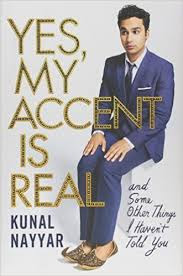
Synopsis (From GoodReads):
Of all the charming misfits on television, there’s no doubt Raj from The Big Bang Theory
— the sincere yet incurably geeky Indian-American astrophysicist —
ranks among the misfittingest. Now, we meet the actor who is every bit
as loveable as the character he plays on TV. In this revealing
collection of essays written in his irreverent, hilarious, and
self-deprecating voice, Kunal Nayyar traces his journey from a little
boy in New Delhi who mistakes an awkward first kiss for a sacred
commitment, gets nosebleeds chugging Coca-Cola to impress other
students, and excels in the sport of badminton, to the confident,
successful actor on the set of TV’s most-watched sitcom since Friends.
Going behind the scenes of The Big Bang Theory
and into his personal experiences, Kunal introduces readers to the
people who helped him grow, such as his James Bond-loving, mustachioed
father who taught him the most important lessons in life: Treat a
beggar as you would a king. There are two sides to every story. A smile
goes a long way. And, when in doubt, use a spreadsheet. Kunal also
walks us through his college years in Portland, where he takes his first
sips of alcohol and learns to let loose with his French, 6’8”
gentle-giant roommate, works his first-ever job for the university’s
housekeeping department cleaning toilets for minimum wage, and begins a
series of romantic exploits that go just about as well as they would for
Raj. (That is, until he meets and marries a former Miss India in an
elaborate seven-day event that we get to experience in a chapter titled
“My Big Fat Indian Wedding.”)
Review:
Kunal Nayyar plays one of television's most beloved characters, Raj Koothrappali, in The Big Bang Theory. When I heard he had written a memoir, I didn't know what to expect. How could a 35 year-old have enough life experience to fill an entire book? Well, I needn't have been concerned. This book shares some wonderful life-lessons (and also pays homage to his amazing father).
What I liked:
This book was written in such a way that it served two purposes: autobiography and life-lessons. First, it did give a rough retelling of his life history (where he is from, information about his parents, etc.). But he does this by telling anecdotes of moments in his life where he learned something important. I loved that.
Often, the first half of any memoir is a boring recounting of one's life. Usually, I want to skip ahead to the section where the celebrity finally becomes famous and will start to spill some juicy gossip.
But each of his stories are compelling. The majority of his chapters are about his experiences in college. Kunal came to the U.S. to study economics in Portland, Oregon. What an abrupt change from his life in India! He writes a lot about being an outsider trying to fit in with his peers. I think many of us can relate to this. Whether you move to a new school or job, or move to a foreign country, being the new person is scary! Being away from home for the first time in a new culture must have been very daunting.
The Wedding:
Of all the sections, I really enjoyed the way Kunal spoke of his courtship and wedding to former Miss India, Neha Kupur. This was not only a celebration of his culture, but of his loving family. Amid the lavish parties and rituals, Kunal takes the time to acknowledge his parents and brother and really appreciate all they have done for him.
I found this book to be a wonderful fish out of water account of Kunal Nayyar's life. I only wish I could have listened to the audio book so I could hear him speak his written words.
Rating:
Release Date: September 15th, 2015
Genre: Memoir
Source: Public Library
Format: Hardback Book
Recommendation: A book for anyone who has had to navigate a new situation (basically everyone). This book shows how a person gets what they want in life, while treating others with kindness and respect.
SHARE ON:


I am writing this post today, not as a rant, but to compare two wildly different representations of how people on "The Spectrum" are shown in the media. I have been thinking a lot about this lately as I read Cassandra Clare's Lady Midnight. I couldn't be more pleased with how her character Ty (short for Tiberius) is shown. When I think of the television show The Big Bang Theory, I cringe at how the character of Sheldon seems to be the butt of most jokes.
In both Lady Midnight, and The Big Bang Theory, there is never an explicit acknowledgement that Ty or Sheldon are autistic, but the signs are obvious. Ty is sensitive to noise, and textures; he needs routines and can't look people straight in the eye. Sheldon has similar issues: he can only sit in a specific chair, has routines for eating food, and doesn't understand many social norms.
Both The Big Bang Theory and Lady Midnight seem to go to great pains to omit the term of autism in their stories. I actually went to a forum at Silicon Valley ComicCon that had the writers for the Big Bang Theory as speakers. They said Sheldon WAS on the spectrum, but that they didn't want him to be "labeled". Cassandra Clare also doesn't actually say Ty is autistic. In some ways, I can understand why both have done this. They want the audience to see these characters as real people. But I wish there wasn't such a stigma surrounding the term. There is nothing wrong with being autistic. This is just another presentation of what it is to be human. Yes, people dealing with autism have certain issues with social interactions, and some of these issues are severe. But I really wish people would stop making it a shameful term (okay, I guess I did have a mini rant inside of me).
When I think about how Sheldon's issues are dealt with on The Big Bang Theory I cringe. All of his seemingly quirky behavior is his way of coping with stress. But most people just make fun of it. The only character that seems to have developed any true empathy for Sheldon is Penny. Once in a while, Sheldon will set the other characters straight and explain why he is behaving that way. But I think after nine seasons, you would think that the other characters would be more sympathetic.
Contrast that to Lady Midnight where, in his family setting, everyone just accepts Ty as he is. No one berates him for his behaviors. His older brother, Jules, constantly thinks of ways he can adapt items for Ty to use as fidget toys, and he is attuned to situations that will be upsetting to Ty. The family sees the positive things Ty contributes: he is great at solving problems, finding information and using technology. Jules worries about how Ty will be treated if he goes to the Scholomance school. He points out that instead of accepting differences in people, the Clave (the government in charge of Shadowhunters) prefers to make different people keep to the shadows. They don't want to acknowledge that there are a variety of people who may be better suited to tasks other than being a Shadowhunter.
Isn't that what our society also does? I think that if people are different there is a tendency to try and "fix" them, rather than look at how they are contributing to society in their unique way. This is why I enjoy fantasy novels so much. The authors can point out real-life issues through the mask of another universe.
I have not finished the book yet, so I am hoping that Cassandra Clare doesn't kill Tiberius off or have something awful happen to him later in the series. I just hope that people will read Lady Midnight and truly SEE Ty's character as a wonderful, unique person who will do amazing things in life. He is not a burden. He is not "special". Tiberius is simply himself, and that is enough.
Updated Note: In my post, I used both the terms Autistic and dealing with Autism. I know there is a huge debate as to what the correct phrase should be. And I struggled with the phrases to use. There is a wonderful article about the pros and cons of each term: Identity-First Language on the Autistic Self Advocacy Network if you want to learn more.
SHARE ON:


 Posts
Posts